
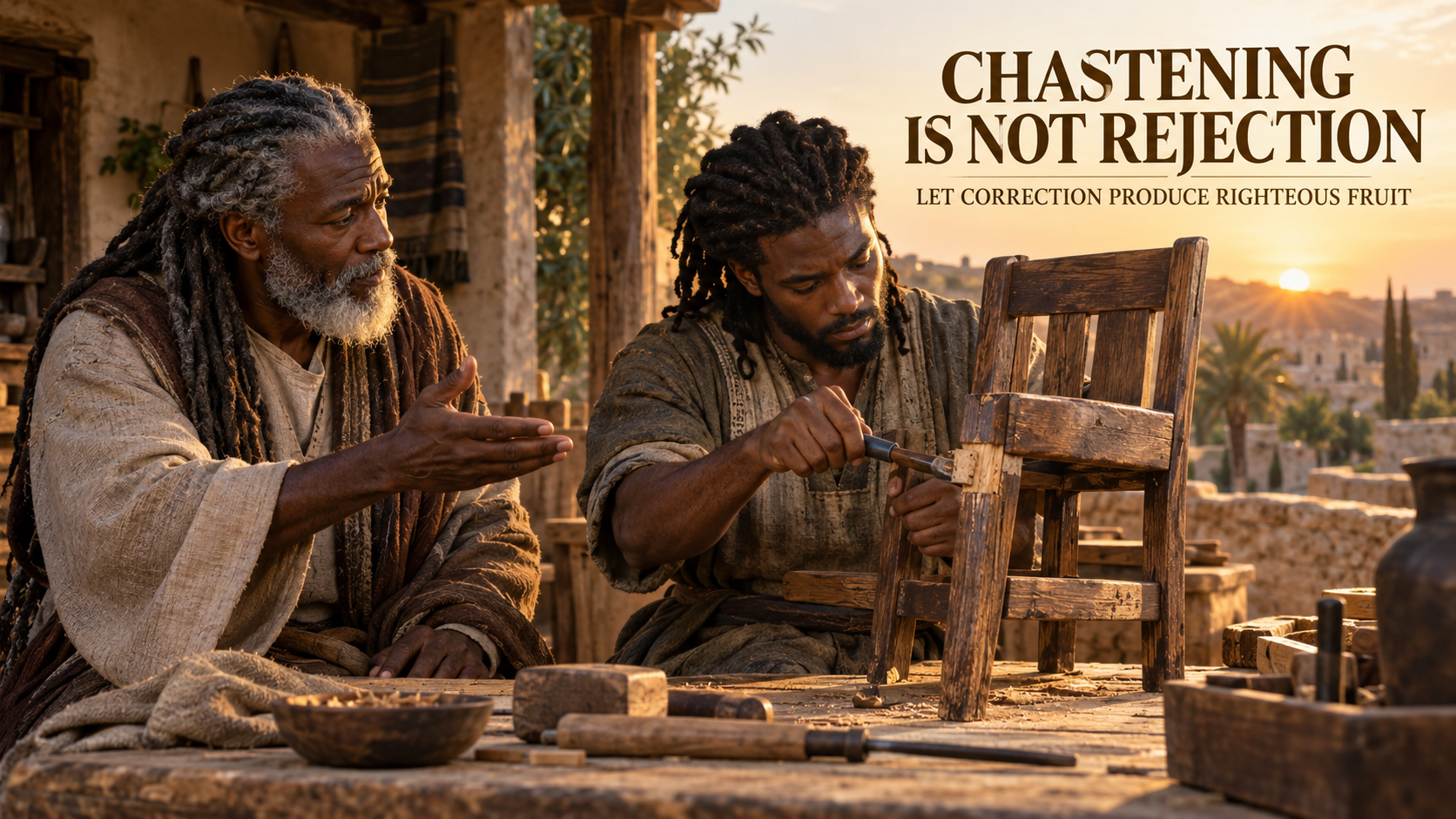
Many people ask YAHUAH to deliver them, restore them, and use them—but resist Him when His answer arrives as correction.
We welcome the promise and fight the pruning. We ask for discernment, then become offended when truth exposes us. We palal for a clean heart, then defend the very habit YAHUAH is putting His finger upon. We say we want freedom, but when correction touches our pride, our relationships, our mouth, our money, our appetites, or our private conduct, we call it rejection.
That confusion will keep a person immature.
YAHUAH does not correct His people because He has abandoned them. He corrects because covenant love refuses to leave destruction unchallenged.
Proverbs 3:11–12 — “My son, despise not the chastening of YAHUAH; neither be weary of His correction: for whom YAHUAH loveth He correcteth; even as a father the son in whom he delighteth.”
Correction is not proof that you are unwanted. It may be evidence that YAHUAH is dealing with you as His own.
Do not run from the hand that is removing what would have ruined you.
Chastening Is the Work of Covenant Love
The flesh wants love without correction. Pride wants affirmation without examination. Rebellion wants promises without government. But the love of YAHUAH is not sentimental permission to remain bound, disordered, and unfruitful.
Hebrews 12:5–6, 10–11 — “My son, despise not thou the chastening of YAHUAH, nor faint when thou art rebuked of Him: for whom YAHUAH loveth He chasteneth, and scourgeth every son whom He receiveth… He for our profit, that we might be partakers of His set-apartness. Now no chastening for the present seemeth to be joyous, but grievous: nevertheless afterward it yieldeth the peaceable fruit of righteousness unto them which are exercised thereby.”
The passage does not pretend chastening feels pleasant. It calls it grievous. The issue is not whether correction hurts. The issue is what the correction is producing.
YAHUAH is not committed to protecting the false version of you that sin constructed. He is committed to forming the obedient son or daughter He called. His correction reaches beneath appearances. It exposes the motive behind the ministry work, the control beneath the concern, the envy beneath the criticism, the fear beneath the anger, and the secret appetite beneath the public set-apartness.
That exposure can feel severe because we often confuse what we have protected with who we are.
But correction from YAHUAH does not destroy righteous identity. It confronts what is destroying it.
Do Not Despise It, and Do Not Faint
Hebrews gives two warnings: do not despise correction, and do not faint under it.
Some despise chastening by becoming hard. They argue, deflect, accuse the messenger, change assemblies, cut off accountability, or gather people who will agree with them. They do not examine the rebuke; they attack the discomfort it created.
Others faint. They collapse into shame and say, “I am worthless. YAHUAH is finished with me. I will never change.” This may sound humble, but it still refuses the purpose of correction. Shame stares at self until obedience disappears. True conviction identifies the sin, turns, repairs what can be repaired, and walks forward under mercy.
To despise correction is to say, “I do not need this.”
To faint under correction is to say, “I cannot survive this.”
Faith says, “YAHUAH, show me what is true, remove what is corrupt, and teach me to obey.”
Pain Does Not Make the Rebuke False
Many of us carry wounds from being mocked, controlled, humiliated, or punished without mercy. Because correction was delivered corruptly in the past, every present correction can feel like another attempt to crush us.
The body tightens. The mind prepares a defense. The heart hears rejection before the other person has finished speaking.
That wound must be acknowledged—but it must not become the ruler.
If you were abused, the abuse was not righteous merely because an authority figure called it discipline. If someone used Scripture to dominate you, YAHUAH was not the author of their cruelty. Yet the evil use of correction does not cancel the righteous correction of YAHUAH.
A wounded person must learn to separate humiliation from conviction. Humiliation says, “You are nothing.” Conviction says, “This conduct cannot remain.” Humiliation offers no righteous path forward. Conviction calls for tashubah and shows where obedience must begin. Humiliation seeks control. Righteous correction seeks restoration and the peaceable fruit of righteousness.
Do not let yesterday’s abusive voice make you deaf to today’s truthful warning.
Do Not Call Abuse the Chastening of YAHUAH
Spiritual authority does not have permission to rename cruelty as correction.
A husband cannot terrorize his household and call it order. A parent cannot shame a child’s identity and call it training. A teacher cannot demand unquestioning loyalty to personal opinions and call resistance rebellion. An assembly cannot conceal wrongdoing and call silence submission.
Those who correct others must also remain correctable.
Galatians 6:1 — “Brethren, if a man be overtaken in a fault, ye which are spiritual, restore such an one in the spirit of meekness; considering thyself, lest thou also be tempted.”
The aim is restoration. Meekness is not weakness, and truth is not cruelty. Righteous correction can be direct, but it does not feed the pride of the person delivering it.
If correction is necessary, speak what can be established. Address conduct rather than cursing identity. Do not exaggerate. Do not expose publicly what should first be handled privately. Do not demand immediate restoration of trust when the fruit of tashubah has not yet appeared. Do not use another person’s weakness to advertise your own authority.
YAHUAH will judge the corrected and the corrector.
Not Every Hard Season Means You Are in Rebellion
We must also refuse careless judgment. Not every affliction is punishment for personal sin. Iyob suffered while his friends built accusations from conclusions they could not prove. In Yahuchanun 9, the disciples saw a man born blind and asked whose sin caused it. YAHUSHA refused their false choice.
Some pressure is correction. Some is testing. Some is persecution. Some is the consequence of another person’s sin. Some is the pain of living in a corrupted world. Some battles require endurance, not self-accusation.
Therefore, do not inspect every suffering person as though pain itself proves guilt. And do not force a confession merely to satisfy your explanation for what they are enduring.
The right response is humble examination before YAHUAH:
“Is there sin I must confess?”
“Is there an instruction I have delayed?”
“Is there a consequence I need to accept?”
“Or am I being called to endure faithfully without inventing an accusation against myself?”
The Ruach Ha’Qudash brings light. Condemnation creates a fog in which everything feels guilty but nothing is named. When YAHUAH corrects, receive the specific truth He reveals. When no sin is established, remain faithful and do not manufacture one.
The Fruit Reveals Whether Correction Was Received
Tears do not prove tashubah. Feeling embarrassed does not prove tashubah. Apologizing because consequences became uncomfortable does not prove tashubah.
Scripture describes a visible change of posture.
2 Corinthians 7:10–11 — “For righteous sorrow worketh tashubah to deliverance not to be repented of: but the sorrow of the world worketh death. For behold this selfsame thing, that ye sorrowed after a righteous sort, what carefulness it wrought in you, yea, what clearing of yourselves, yea, what indignation, yea, what fear, yea, what vehement desire, yea, what zeal, yea, what revenge!”
Righteous sorrow moves. It becomes carefulness. It stops protecting the hidden door. It tells the truth without editing the account to preserve reputation. It accepts that trust may take time to rebuild. It removes access to the old sin. It makes restitution where possible. It submits to righteous accountability. It does not keep asking everyone to forget what its present conduct continues to repeat.
If the same excuses remain, the correction has not yet been received.
If the same provision remains, the sin is still being planned for.
If the same victims are still being silenced, the apology has not become justice.
If every messenger becomes the enemy, pride is still sitting in judgment over truth.
The peaceable fruit of righteousness does not appear in speech alone. It appears in changed patterns.
Watch the Teaching
Watch Rejoice In Your Chastisement from the official Natsarym of YAHUSHA channel. This teaching strengthens the call to stop interpreting correction as abandonment and to receive the refining work that produces maturity.
The Apocrypha Witness: Endure the Refining
Sirach speaks directly to those who enter the service of YAHUAH and then become shaken when testing begins:
Sirach 2:1–5 — “My son, if thou come to serve YAHUAH, prepare thy soul for temptation. Set thy heart aright, and constantly endure, and make not haste in time of trouble. Cleave unto Him, and depart not away, that thou mayest be increased at thy last end. Whatsoever is brought upon thee take cheerfully, and be patient when thou art changed to a low estate. For gold is tried in the fire, and acceptable men in the furnace of adversity.”
This Apocrypha witness does not teach us to celebrate evil or remain under abuse. It teaches us not to abandon YAHUAH when service becomes costly and our character is tested.
Fire reveals what ease can conceal. Pressure exposes whether our obedience depended upon comfort, recognition, control, or immediate reward. The furnace does not create every impurity it reveals. Often it brings what was already present to the surface so it can no longer hide.
Do not make haste in trouble. Do not make permanent decisions while pride is burning. Set your heart aright. Cleave to YAHUAH. Let the trial expose what needs tashubah and strengthen what must endure.
Stop Rebuking What YAHUAH Is Using to Train You
Not every uncomfortable consequence is an attack of the adversary.
If you repeatedly lie and people no longer trust you, the loss of trust is not persecution.
If you spend without restraint and your household enters disorder, the pressure is not automatically spiritual warfare.
If you refuse counsel, wound people with your mouth, and then find yourself isolated, do not call every broken relationship proof that everyone is against you.
If you keep returning to secret sin and your peace is disturbed, do not rebuke the conviction you asked YAHUAH to send.
There are moments when the warfare ends by resisting the adversary. There are other moments when the lesson begins by submitting to YAHUAH.
Before you bind, rebuke, flee, or accuse, palal: “YAHUAH, is this pressure exposing something I must change?”
If He answers, do not negotiate.
Receive Correction in Righteous Order
When truth reaches you, become still before you defend yourself. Listen for the part that is true even if the messenger delivered it imperfectly. A flawed messenger can still identify a real wound. You do not have to accept false accusations in order to receive what is established.
Bring the matter before YAHUAH in palal. Open the Scriptures that govern the conduct in question. Ask the Ruach Ha’Qudash to expose both obvious sin and the motive beneath it.
Name the matter plainly. Not “mistakes were made,” but “I lied.” Not “things became inappropriate,” but “I crossed a boundary.” Not “they misunderstood my tone,” but “I spoke with cruelty.” General confession protects specific rebellion.
Then turn. Remove the contact, account, substance, access, excuse, or secret arrangement that feeds the pattern. Tell the truth to those affected. Make restitution when it is possible and righteous. Accept consequences without using tears, anger, prophecy, or spiritual language to escape them.
Remain teachable after the emotion passes. Many people receive correction for one night and return to self-defense by morning. Write the instruction down. Establish accountability. Measure fruit over time. Let obedience become the answer.
And do not demand applause for doing what righteousness required.
Examine Your Response to Correction
When someone corrects you, do you first seek truth or search for a flaw in the messenger?
Do you confuse conviction with rejection because of earlier abuse?
Have you called consequences persecution when they were produced by your own choices?
Do you apologize quickly but resist the change that would make the apology credible?
Have you used spiritual warfare language to avoid submission, restitution, or accountability?
Do you become silent, disappear, threaten to leave, or collapse into shame whenever your conduct is addressed?
Are you correcting others in meekness, or using their fault to strengthen your control?
Is there a repeated instruction from YAHUAH that you continue to delay?
What peaceful fruit of righteousness should be visible if you truly receive that instruction today?
Do not answer to appear mature. Let the Ruach Ha’Qudash search the place in you that still believes correction is an enemy.
Let the Pruning Finish Its Work
Yahuchanun 15:2 — “Every branch that beareth fruit, He purgeth it, that it may bring forth more fruit.”
Even fruitful branches are pruned.
YAHUAH is not only removing open rebellion. He is cutting back the pride that grew beside the gift, the self-reliance that grew beside the strength, the need for praise that grew beside the service, and the fear of people that grew beside the desire to belong.
Do not measure His love by how comfortable He keeps you. Measure His faithfulness by the righteous fruit His hand is producing.
David could say:
Psalm 119:67, 71 — “Before I was afflicted I went astray: but now have I kept Thy word… It is good for me that I have been afflicted; that I might learn Thy statutes.”
That is the testimony of someone who allowed pain to become instruction. He did not worship the affliction. He honored the fruit.
YAHUSHA also speaks plainly:
Revelation 3:19 — “As many as I love, I rebuke and chasten: be zealous therefore, and make tashubah.”
The answer to chastening is not hiding. It is zeal and tashubah.
Come out of self-defense. Come out of condemnation. Come out of the cycle of apology without change. Let YAHUAH name what must die, heal what has been wounded, and establish what is righteous.
Correction is not rejection when the hand correcting you is forming you for set-apartness.
Closing Palal
YAHUAH, our Aluah, give me a teachable heart. Deliver me from the pride that despises correction and from the shame that faints beneath it. Show me where I have mistaken conviction for rejection, consequences for persecution, and self-defense for discernment.
By Your Ruach Ha’Qudash, expose every habit, motive, relationship, and hidden agreement that resists Your order. Where I have sinned, give me courage to name it without excuse. Lead me into complete tashubah. Teach me to make restitution, accept righteous accountability, remove provision for sin, and produce fruit worthy of the change I confess.
Heal the wounds left by cruel and corrupt authority. Separate the voice of abuse from Your voice of truth. Do not allow what others did to me to make me unreachable when You correct me. Give me wisdom to reject false accusation without rejecting established truth.
Make me gentle and clean when I must correct another person. Remove pride, exaggeration, control, and the desire to humiliate. Let every correction seek restoration and remain under Your judgment.
Finish the pruning You have begun. Let present grief yield the peaceable fruit of righteousness. Form obedience in my private life, order in my household, truth in my mouth, humility in my service, and endurance in every trial.
I receive Your correction as the work of covenant love, and I ask this in the name and authority of YAHUSHA Ha’Mashiach, Aman,
