
Who Are You When No One Is Watching?
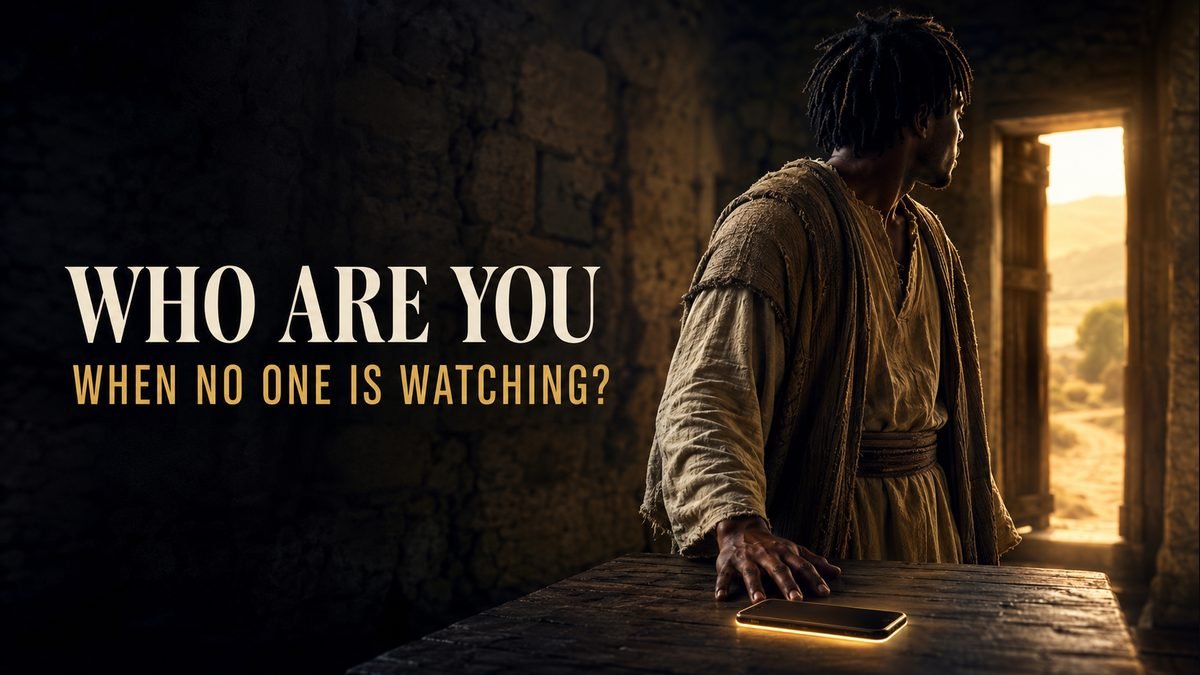
Public conduct can create a reputation, but private conduct reveals character.
It is possible to speak truth before others while entertaining compromise in secret. A person may appear disciplined, righteous, and devoted while concealing habits that are gradually corrupting the heart. YAHUAH is not persuaded by appearances. He searches the thoughts, motives, desires, and decisions hidden from human sight.
Hidden integrity means remaining obedient when there is no audience, no applause, no immediate accountability, and seemingly no possibility of discovery. It means remembering that even when no person sees you, you still stand before YAHUAH.
YAHUAH Sees Beyond the Public Image
Mishlei—Proverbs 15:3 declares:
“The eyes of YAHUAH are in every place, beholding the evil and the good.”
People see selected moments. YAHUAH sees the complete life.
He sees what happens after the gathering ends. He sees what is opened on the screen, what is deleted from the history, what is concealed from a spouse, what is withheld from accountability, and what is rehearsed within the imagination.
Tehillim—Psalm 139:1–4 declares:
“O YAHUAH, thou hast searched me, and known me.
Thou knowest my downsitting and mine uprising, thou understandest my thought afar off.
Thou compassest my path and my lying down, and art acquainted with all my ways.
For there is not a word in my tongue, but, lo, O YAHUAH, thou knowest it altogether.”
This knowledge should produce more than fear of judgment. It should produce reverence, honesty, and security. Nothing about you is hidden from YAHUAH, yet He still calls you to come into the light, receive correction, and walk in complete tashubah.
Integrity Is More Than Avoiding Discovery
Many people do not reject sin because it is wicked; they avoid it because they fear being caught.
That is reputation management, not integrity.
A person governed by reputation asks:
Will anyone see me?
Can this be traced?
Will this damage my position?
Can I explain it if someone discovers it?
How can I preserve the appearance of righteousness?
A person governed by integrity asks:
Does this honor YAHUAH?
Does this agree with His Word?
Will this strengthen or weaken my obedience?
Would I do this while consciously acknowledging His presence?
What fruit will this produce within me and my household?
Integrity does not depend on surveillance. It flows from reverence for YAHUAH and love for truth.
Joseph’s Decision in the Hidden Place
Bereshith—Genesis 39 records that Joseph was repeatedly tempted by his master’s wife. The opportunity appeared private. The house was empty, the invitation was direct, and Joseph could have imagined that no witness was present.
Yet Joseph answered:
“How then can I do this great wickedness, and sin against Aluah?”
—Bereshith—Genesis 39:9
Joseph did not merely consider what his master might think. He considered YAHUAH.
When the temptation became physical and forceful, Joseph fled. He left his garment behind rather than surrendering his integrity.
This is an essential lesson: sometimes maintaining set-apartness requires immediate departure. You may have to leave the room, end the conversation, block the contact, close the application, refuse the invitation, or surrender something valuable.
Joseph lost his garment, his position, and temporarily his freedom, but he did not surrender his obedience.
It is better to lose an opportunity while remaining clean than to gain temporary pleasure through hidden rebellion.
Hidden Compromise Does Not Remain Small
Secret sin often begins with internal permission.
The person says:
“I am only looking.”
“I will stop before it goes too far.”
“This is the last time.”
“No one is being harmed.”
“I deserve some relief.”
“I can confess later.”
“YAHUAH knows my heart.”
But YAHUAH knowing the heart is not permission to continue. It is the reason deception must be confronted.
Hidden compromise commonly develops through a progression:
Temptation presents an opportunity.
Curiosity causes the person to linger.
The mind begins imagining participation.
Internal resistance becomes weaker.
The person acts upon the desire.
Secrecy protects the behavior.
Repetition forms a pattern.
Justification silences correction.
The pattern begins controlling the person.
What remains unconfessed is often repeated. What is repeatedly practiced becomes easier to defend. What is continually defended eventually hardens the heart.
Privacy and Secrecy Are Not the Same
Privacy is a legitimate boundary. Not every personal matter belongs before the public. Palal, grief, marital conversations, family matters, healing, and personal correction may require discretion.
Secrecy is different. Secrecy is used to protect conduct that would not survive truthful examination.
Ask yourself:
Am I protecting something personal, or concealing something unrighteous?
Would mature accountability confirm that this boundary is wise?
Am I hiding because I need time to heal, or because I want freedom to continue?
Does this private area produce peace and righteous fruit, or fear and double-mindedness?
Would I feel betrayed if someone close to me were secretly doing the same thing?
Not everything private is sinful, but sin frequently demands secrecy in order to grow.
The Digital Hidden Place
For many people, the most revealing room in the house is the device held in the hand.
A screen can provide secret access to lust, pornography, emotional affairs, gambling, gossip, covetousness, uncontrolled shopping, false teaching, rage, comparison, and endless distraction.
Digital secrecy may include:
Hidden accounts
Deleted conversations
Private browsing
Disappearing messages
Saved images
Secret purchases
Concealed subscriptions
Following people who awaken former appetites
Maintaining contact with destructive relationships
Consuming material you would immediately hide from your household
Technology does not create every desire, but it can provide continuous access to desires that should be confronted.
If a device repeatedly becomes a gate to compromise, establish physical boundaries. Remove applications, block websites, change access permissions, place devices in shared spaces, and allow appropriate accountability.
Do not ask YAHUAH to deliver you from something while preserving convenient access to it.
Integrity in Money and Responsibility
Hidden integrity also concerns money, work, promises, and stewardship.
A person may appear generous while hiding debt, reckless spending, unpaid obligations, dishonest records, or money secretly taken from the household. Someone may appear hardworking while wasting paid time, falsifying information, or taking credit for another person’s labor.
Luqas—Luke 16:10 teaches:
“He that is faithful in that which is least is faithful also in much: and he that is unjust in the least is unjust also in much.”
Small dishonesties are not harmless. They reveal how a person handles responsibility when consequences appear distant.
Faithfulness in little matters prepares a person to carry greater responsibility without being corrupted by it.
Integrity Within the Household
A household cannot remain healthy when its peace depends upon concealed behavior.
Secret addictions, hidden spending, emotional affairs, dishonest communication, private resentment, or double standards eventually affect everyone—even when family members do not yet understand the source.
Children also learn from the difference between public teaching and private conduct. They notice whether adults apologize, tell the truth, keep promises, control their speech, and practice what they instruct others to do.
Household integrity requires humility. Parents, husbands, wives, guardians, and ministry leaders must be willing to confess wrongdoing without using authority to silence necessary correction.
Position does not remove accountability. Greater responsibility requires greater integrity.
Exposure Can Be an Act of Mercy
Luqas—Luke 12:2 declares:
“For there is nothing covered, that shall not be revealed; neither hid, that shall not be known.”
Exposure is painful, but continued concealment is more destructive.
When YAHUAH allows something hidden to be uncovered, do not immediately concentrate on preserving your image. Concentrate on receiving correction, making restitution, and completing tashubah.
Conviction is not abandonment. Exposure can interrupt a pattern before it destroys more of your life.
The correct response is not:
Blaming the person who discovered it
Minimizing the behavior
Attacking the messenger
Offering partial truth
Confessing only what can already be proven
Demanding immediate trust
Using tears as a substitute for changed conduct
True confession agrees with the truth. True tashubah produces a changed direction.
Private Obedience Also Matters
Not everything hidden is wicked. Some of the most important acts of obedience occur where no one applauds.
YAHUSHA taught that the Father sees giving, fasting, and palal performed in secret. This means private obedience is never wasted.
YAHUAH sees:
The temptation you rejected
The message you refused to send
The website you closed
The money you returned
The apology you offered
The appetite you disciplined
The private tears you poured out before Him
The kindness for which you received no recognition
The restraint you practiced when you could have retaliated
The daily obedience that no one celebrated
Do not become discouraged because people do not see your faithfulness. The objective is not human recognition. The objective is to please YAHUAH and remain established in YAHUSHA Ha’Mashiach.
A Supporting Witness From the Apocrypha
The following witness comes from the Apocrypha. It is included as supporting wisdom and not as the foundation of this teaching. The Canon has already established that YAHUAH sees every hidden matter.
Sirach 23:18–19 describes a person committing adultery while reasoning that darkness and walls will conceal him. The passage warns that such a person fears human eyes while forgetting that the Most High sees every path and hidden place.
This witness reinforces the Canon’s warning: darkness is not concealment before YAHUAH. Walls, passwords, distance, and human silence cannot remove His knowledge.
A Cautious Witness From the Pseudepigrapha
The following witness comes from Jubilees, a Pseudepigraphal work. It must be weighed cautiously against the Canon and is not being used to establish doctrine.
Jubilees 39:6–9 expands the account of Joseph’s temptation. It presents Joseph remembering righteous instruction, repeatedly refusing the woman’s demands, and fleeing when she attempted to seize him.
The Canon in Bereshith—Genesis 39 already establishes Joseph’s integrity. Jubilees is included only as an additional witness emphasizing that Joseph’s refusal was sustained, deliberate, and rooted in remembered instruction.
A Hidden-Integrity Examination
Set aside uninterrupted time and answer these questions honestly.
Your inner life
What thoughts do I repeatedly entertain but refuse to confess?
What desire becomes strongest when I feel lonely, rejected, angry, or exhausted?
Have I privately agreed with something I publicly condemn?
Do I fear discovery more than I fear disobedience?
Your devices
What would my browsing, messages, purchases, and saved material reveal?
Do I maintain accounts or conversations that my household does not know about?
What digital access point repeatedly leads me into compromise?
What must be deleted, blocked, canceled, or surrendered?
Your relationships
Am I maintaining a secret emotional or sexual connection?
Have I concealed the true nature of a relationship?
Am I receiving attention that belongs within my covenant household?
Have I kept someone close because they validate my rebellion?
Your finances and responsibilities
Have I hidden purchases, debt, income, or financial decisions?
Do I keep my word when there is no immediate consequence?
Am I honest in my work when no supervisor is watching?
Have I used ministry, family, or community resources for myself without permission?
Your walk before YAHUAH
Is my public devotion greater than my private obedience?
Do I seek recognition for what should be offered to YAHUAH?
What instruction have I delayed obeying?
What hidden matter is the Ruach Ha’Qudash bringing to my attention now?
Do not answer defensively. The purpose is not condemnation but truthful examination, tashubah, cleansing, and restored integrity.
A Practical Plan for Restoring Hidden Integrity
1. Tell the complete truth
Confess the behavior and the agreement supporting it. Do not use vague language to make serious compromise sound harmless.
2. Bring the matter before YAHUAH
Acknowledge that the sin was never hidden from Him. Ask for forgiveness, cleansing, and strength to walk differently.
3. Remove the access point
Delete the account, end the relationship, surrender the password, cancel the subscription, return what was taken, or establish the required boundary.
4. Seek appropriate accountability
Choose a mature person who values truth, restoration, and Scriptural order. Accountability should be honest, consistent, and specific.
5. Make restitution where necessary
Confession does not erase every responsibility. Return what was taken, correct false information, repay what is owed, and acknowledge the people harmed by your conduct.
6. Accept that trust may require time
Forgiveness does not automatically restore access, responsibility, or trust. Do not pressure wounded people to behave as though nothing happened. Demonstrate change through consistent fruit.
7. Build a private life of obedience
Replace hidden compromise with hidden faithfulness. Establish regular Scripture study, palal, fasting, useful work, service, rest, and disciplined boundaries.
Closing Exhortation
Who you are when no one is watching matters.
The hidden life eventually becomes visible through fruit. Secret rebellion produces fear, instability, deception, and bondage. Private obedience produces clarity, discipline, courage, and peace.
Do not wait for exposure before telling the truth.
Do not preserve a public image while your private life collapses.
Do not confuse concealment with freedom.
YAHUAH already sees the complete matter. Come into the light. Confess without excuse. Remove the access point. Receive correction and walk in complete tashubah.
Through YAHUSHA Ha’Mashiach, you can become the same person in private that you appear to be in public.
Closing Palal
YAHUAH, my Aluah, search me and reveal every hidden thought, desire, agreement, and practice that opposes Your Word. Remove deception from my heart and give me courage to tell the complete truth.
I confess that I have sometimes feared human discovery more than I feared disobedience. Forgive me for protecting appearances, hiding compromise, and delaying tashubah.
Ruach Ha’Qudash, expose every secret access point and strengthen me to remove it. Teach me to flee temptation without negotiation and to choose obedience even when no person is watching.
Restore integrity within my thoughts, relationships, finances, responsibilities, devices, and household. Give me humility to receive correction, make restitution, accept accountability, and rebuild trust through consistent fruit.
Establish within me a private life of Scripture, palal, discipline, and set-apartness. Let my hidden conduct agree with my public confession. Make me faithful in little things and trustworthy with every responsibility You place before me.
I surrender my reputation, desires, habits, and concealed places to Your authority. Bring every part of my life into the light and teach me to walk without deception.
I ask these things in the name and authority of YAHUSHA Ha’Mashiach, Aman.
